
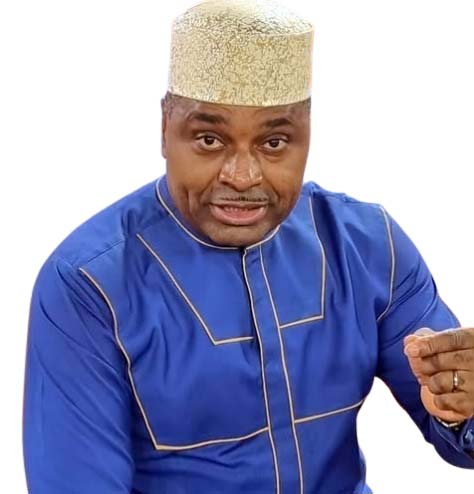
Slams Nafiu Bala’s camp as meddlesome interlopers
By Nnamdi Ojiego,
A fresh dispute over the leadership of the African Democratic Congress (ADC) has opened a new front in the party’s internal crisis, with rival claims, legal arguments and allegations of political interference now colliding. At the centre of the controversy is the role of the Independent National Electoral Commission (INEC) and the interpretation of a Court of Appeal directive on maintaining the status quo, which opposing camps have read in sharply different ways.
In this interview, a chieftain of the party and lawyer, Kenneth Okonkwo, dismisses the claims by a faction challenging the current leadership, describing them as “meddlesome interlopers” with no standing in the party. He insists that INEC’s recognition of the leadership led by David Mark remains valid, and argues that no court order has altered that position. Okonkwo also raises concerns over what he describes as external pressure being mounted on the electoral body, warning of a broader attempt to destabilise the party ahead of the 2027 general election. Excerpts:
There is a letter before INEC from lawyers representing a faction within your party, asking the Commission to enforce a Court of Appeal directive and remove Senator David Mark’s name as ADC chairman. What is your response?
Well, first and foremost, let me say that it is very ridiculous for a man called Nafiu Gombe to go to court to challenge the leadership of ADC. On May 17, 2025, by a letter dated that day, he resigned from ADC. He signed it on May 18, and it took effect on May 26. He stated clearly that he was resigning to make way for a smooth and effective coalition and restructuring, in his own handwriting. After resigning, they went back to him and are now using him, thinking he can truncate ADC because APC is desperate.
You have suggested possible external influence. What points to that?
We are politicians. What is his motive? Not to be anything in ADC, since he has resigned, but to truncate ADC. I had been here when they claimed the trial court gave them an order. I read where the court rejected their ex parte motion and told them to put us on notice. INEC recognized us. Once INEC recognizes you, you cannot use an interlocutory injunction to stop an action already executed. We went to the Court of Appeal and were told this is not even a judgment, but an interlocutory issue. The court said you must first seek leave before appealing such a matter.
On the legal issue, the opposing camp is relying on the Court of Appeal’s directive to maintain status quo ante bellum. How do you interpret that order?
Maintaining status quo means you should not do anything that will disadvantage either party. INEC has already recognized us, and we are on its portal as the leaders. What the court said confirmed our leadership and directed that nothing should be done to alter it, since that is the subject before the court.
They argue that “status quo” refers to the situation before INEC recognised the current leadership. Do you agree?
Status quo means there is a national leadership in place. It was Professor Mahmood Yakubu who recognized the ADC leadership. We had 18 months of negotiations before arriving at this point. I was part of it. As a lawyer, I asked critical questions and was shown that these people resigned and the NWC dissolved itself for the greater good.
Their lawyers are Senior Advocate of Nigeria (SAN) and have written to INEC. Does that not strengthen their case?
Mike Igini once said if democracy is truncated in this country, it will be by lawyers. There will always be people who undermine the law. A lawyer went to court seeking reliefs and is now claiming those reliefs have been granted when the court has not ruled. This is the second letter they are writing to INEC. The first was on March 16. INEC treated it for what it is, nonsense.
There are claims that members of the previous National Working Committee were forced to resign. How do you respond?
The National Working Committee led by Ralph Nwosu held a meeting and agreed by resolution that they would all resign. That is why the letters appear uniform. The important point is that the content, including the resignation statements, is in each person’s handwriting.
The resignation letters appear uniform in format. Can you explain that process?
It was a collective decision. They resigned as a body, which explains the format. Each person filled in their details and signed.
If Nafiu Gombe later claim he acted under pressure, how should that be addressed?
Is he a small boy that he should be compelled? A man of that level writing in his own hand? If there are claims of threat, that is for the court to determine. That is why such matters should come by writ of summons, where evidence can be tested, not by originating summons meant for uncontested facts.
You have criticised their legal approach. Why do you believe their case may not stand?
Originating summons is used when facts are not in dispute. If you are alleging coercion, you must come by writ of summons and prove it. By choosing originating summons, that case is already defective.
Do you think this matter is being played out more through public pressure than through the courts?
That is exactly what is happening. Instead of going to court if there is contempt, they are writing letters to INEC.
If INEC were to remove the current leadership from its records, what would that mean?
If INEC does that, then know that APC influenced it. They are using these letters to mount pressure. They wrote on March 16 with the same requests. Why would INEC act now if it ignored them then? What has changed?
Finally, what is your message to party members?
Allow the court to decide. All these letters and propaganda should not replace due process. If there is any grievance, it should be addressed in court, not through pressure on institutions.